 Flattop Gourmet
Recipe
Smash Burgers on the Flattop
A grate gives you stripes. A flattop gives you a crust. Smash burgers are the shortest way to prove that.
You are not making a thick pub burger. You are making maximum contact between beef and hot steel, then getting out of the way. The flavor is the Maillard reaction: amino acids and sugars browning above roughly 300°F. Water is the enemy of that. Water boils at 212°F, and as long as the surface is wet, the energy goes into steam instead of browning.
The smash is not a party trick. It is how you squeeze surface moisture out and force the meat into a thin, even sheet so the steel can do its job before the patty steams itself gray.
Why the flattop wins
Thermal mass. A steel plate holds heat and gives it back on contact. A grate dumps a lot of that heat into air. When a cold ball of beef hits the plate, a good flattop recovers. A thin pan does not.
Contact area. Smash a 3-ounce ball and you get a wide, lacy-edged patty. More contact, more crust, shorter cook. That lacy edge is not garnish. It is extra browned surface.
Steam vs sear. Leave the burger uncovered while the crust sets. Steam is useful later, when you want cheese melted and the bun soft. Use a melting dome after you flip, not before. Lid too early and you braise the beef. The longer argument is on Steam vs sear.
Oil smoke point. You want a thin film, not a puddle. Refined avocado oil (smoke point around 500°F) or another high-heat refined oil will sit through a 400–450°F plate. Extra-virgin olive oil will smoke and taste burnt before the crust is ready. Butter is for the bun, not the smash.
What you need
Beef: 80/20 ground chuck. Fat is insulation and flavor. 90/10 dries out before the crust is honest. Do not add binders, egg, or Worcestershire to the meat. Season the surface, not the mix.
Portion: 3-ounce balls for a double smash (two thin patties, one bun). 4-ounce if you want a single. Roll loose balls. Do not pre-form patties. A pre-formed patty is already a compromise: you cannot smash it thin without tearing.
Salt: Kosher salt, right after the smash. Salt earlier and it starts pulling water. You want that water on the plate as little as possible.
Cheese: American. It melts because it is built to. Cheddar looks serious and then sits there in a rubber sheet.
Buns: Soft potato or squishy diner-style. Toast them on a cooler zone in the fat that is already there. A brioche that sits too tall fights the whole point of a thin burger.
Yield: 4 double smash burgers (8 balls).
Gear
Best value, generic is fine. You already have spatulas. The three tools worth adding are on the starter kit page.
| Slot | What and why |
|---|---|
| 1 | You already have spatulas. Keep the stiffest one for the scrape-flip. Do not buy another. |
| 2 | Second spatula or a smash press. You need something heavy and flat for one hard press in the first 10 seconds. A press is neater. A second spatula works. |
| 3 | High-smoke cooking oil. Refined avocado oil is the boring, correct choice. |
| 4 | Melting dome. Traps steam after the flip so cheese melts without wrecking the crust. |
| 5 | Bench scraper or dedicated griddle scraper. The fond is flavor until it is carbon. Clean between batches. |
Optional later: squeeze bottles for oil and sauce, an infrared thermometer if you like numbers more than the water-droplet test.
The cook
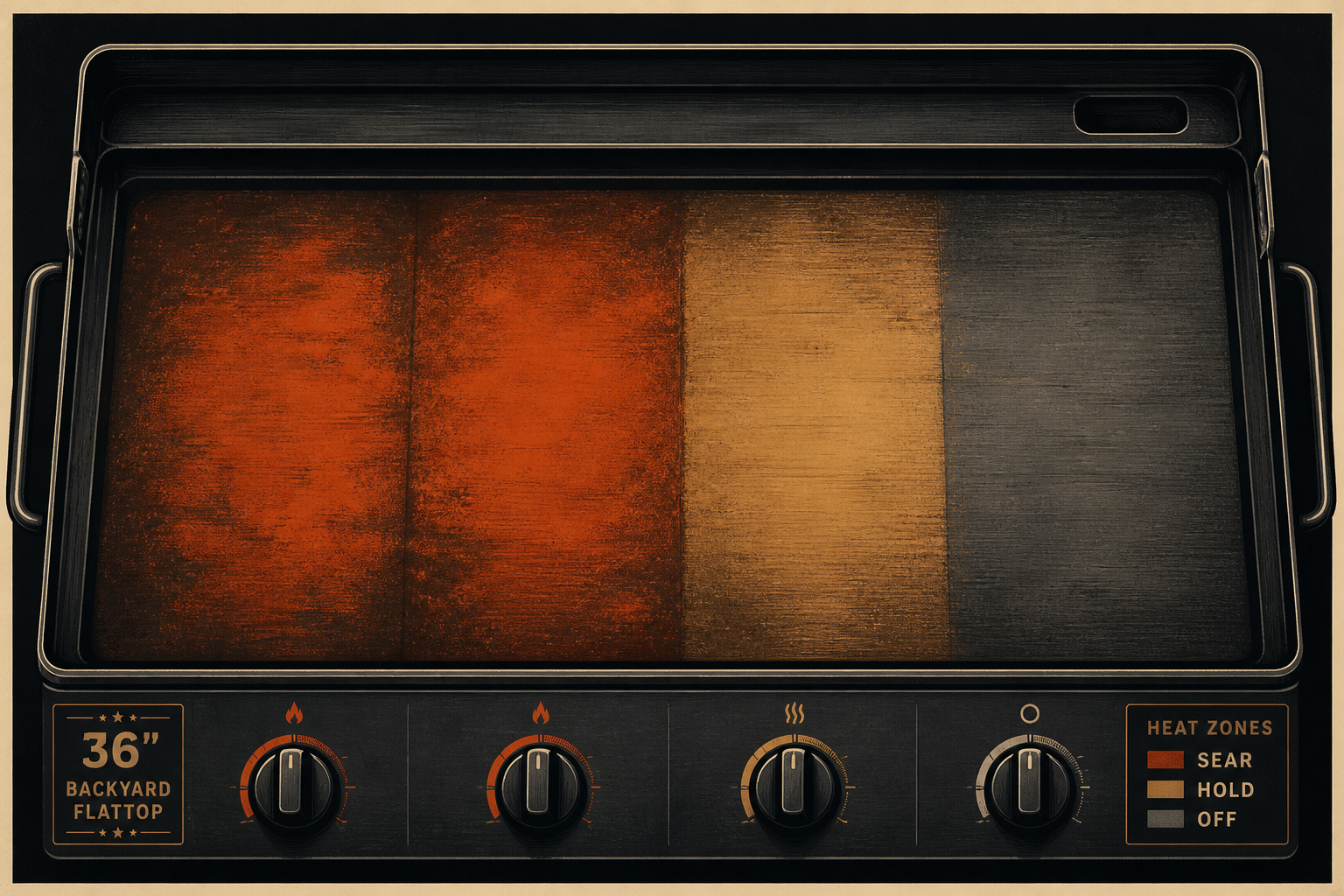
1. Heat the plate in zones. On a 36-inch you have four burners. Do not light all four on high. That turns the whole plate into one angry zone and you lose the bun landing spot.
- Burners 1–2 (left): high. Smash zone. You want roughly 400–450°F. A flick of water should skitter and vanish, not sit and steam.
- Burner 3: medium-low. Buns and a brief hold.
- Burner 4: off, or barely on if the wind is stealing heat. Landing zone for cooked burgers and raw balls waiting their turn.
Preheat 10–15 minutes. The 36-inch has real mass. If you start smashing at minute six, the left side looks hot and the center is still catching up. If it is windy, put the smash zone on the sheltered side. The windward burner runs cooler than the knob claims.
2. Oil a thin film. Wipe it on. If you see puddles, you used too much. Extra oil fries the beef. A film lets it contact the steel.
3. Balls down on burners 1–2 only. Leave a spatula-width between them. Crowding drops the plate temperature and you are back to steam. Three doubles (six balls) is the honest max on the hot half. Do the fourth double as a second wave. The 36-inch can take all eight at once. It should not. You will chase grease and lose crust.
4. Smash once, hard, immediately. You have about 10 seconds while the proteins are still loose. Press to about ¼ inch. You should hear it. Then take the weight off. A second smash after the crust starts to set just squeezes out juice you already earned.
5. Salt the exposed side. Leave it alone. 45–90 seconds. The edges should go lacy and brown. If you peek and the patty slides, it is not ready. The crust is done when a scraper gets under it and the patty comes up with a deep brown face.
6. Scrape and flip. Do not lift. Scrape. The brown is stuck on purpose. That is the point.
7. Cheese, then dome. Slice of American on each patty. Dome for 15–20 seconds. That is the one moment steam is invited.
8. Buns on burner 3. Cut side down in the beef fat you already rendered, 20–30 seconds. You want color, not a cracker. If fat is pooling toward the rear trough, pull a little back onto the bun zone with the scraper instead of adding fresh oil.
9. Stack and get it off. Two patties, soft bun, pickle if you want acid. Sauce the bun, not the plate. Eat it hot. A smash burger held for five minutes is a different, worse sandwich.
If it goes wrong
Gray, no crust. Plate was too cool, or you crowded it, or the beef was wet. Pat the balls dry. Give the 36-inch the full 10–15 minute preheat. Cook on the left two burners only.
Whole plate is a grease lake. You fired all four burners and smashed eight balls. Scrape toward the rear trough between waves. Leave burner 4 off so cooked burgers are not sitting in a sauté.
Stuck so hard it tears. You flipped early, or you tried to lift instead of scrape. Give it another 15 seconds, then get the scraper all the way under the edge.
Smoke alarm, acrid oil. Wrong oil, or the plate is past 500°F with a dirty film. Scrape, wipe, drop the heat a notch, switch to a high-smoke refined oil.
Grease flood. 70/30 or a cheap grind with a lot of free water and fat. Stay at 80/20. Drain the lake between batches or the next smash steams in tallow.
Dry center. You smashed a 4-ounce into a single and then left it on too long. Smash thinner and stack two, or pull it the second the cheese melts.